Main menu:


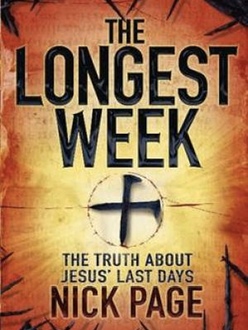
Image of The Longest Week: What Really Happened During Jesus' Final Days

THE LONGEST WEEK
Buy it now at Amazon!

books.gif

For a full range of books by Nick and Claire Page, visit our online bookstore.

Nick’s Speaking Diary

Tues 9th March: Words on the Water, Keswick Literary Festival

Wed 24th March: Woodstock Deanery Lent Course


Nick Page's Facebook Profile

Site search

  • Recent Comments:

    • Rev Anne Ballard: Hi Nick, You may not remember me. I used to be Vicar at Ivinghoe when Heather was around there....
    • Phil Ruse: A well judged comment. Though I admit I’m finding it hard to resist a feeling of schadenfreude....
    • Dave Walker: They often do, yes (though again, wouldn’t want to lump all forums in together). I think Ship of...
    • Dave Walker: Nick, Good comment, thank you. ‘Lumping everyone in together’ is a fairly common thing for...
    • Tim Robinson: MATE i still have a copy of the dead sea files, still makes me laugh out load even now!! Tim
  • Categories

    Archive

    Stuff

    Powered by Laughing Squid

    The Longest Week Live

    This Easter, why not take a walk through the events of Holy Week?

    The Longest Week Live will help you to recreate the events of Holy Week right where you live. The idea is simple: during Holy Week you celebrate the events at the time they actually occurred, according to the gospel accounts, at the place they occurred, according to the gospel accounts… only where you live.

    There are instructions on the Longest Week Live page along with a superimposable map of first century Jerusalem and a suggested timetable. You can do it as a group, or as an individual. Just get your walking boots on, grab a Bible and visit first century Jerusalem, right where you live.

    No comment so far

    In search of Saint Patrick

    It’s Saint Patrick’s Day – the day when the Irish celebrate their Irishness by drinking and… er… well, that’s about it really.

    The truth about Patrick is intriguing.

    He wasn’t Irish. Nor was he Catholic or Protestant. He was English. Or Welsh. Or, at least a Romano-Briton. The only real information we have about him comes from two letters in Latin: the Declaration or Confession and the Letter to the soldiers of Coroticus. The Bible quotations these contain come from Jerome’s Vulgate edition, which was only finished in 405 AD and probably took some time to filter north. He also refers to the Franks as pagans and their conversion is dated to the period 496–508. So he was probably active in Ireland in the second half of the fifth century and died c.493.

    He certainly doesn’t appear to have the Irish gift of the gab. In his old age he described himself as feeling ‘ashamed and I am mightily afraid to expose my ignorance, because, [not] eloquent, with a small vocabulary.’ And he wasn’t very complimentary about some of the people he was living among: ‘I live among barbarians, a stranger and exile for the love of God,’ he wrote.

    Patrick was born in Roman Britain at Bannavem Taberniae. Various suggestions have been given for this place, including Barnstaple in North Devon, St David’s in Wales, or as the Oxford Citionary of Saints puts it, ‘somewhere in the west between the mouth of the Severn and the Clyde.’ That’s narrowed it down a bit, then. I think a southern location more likely, since that had the more heavily populated Romano-British settlements. His family were Christian: his father was a deacon and his grandfather a priest.

    Elsewhere he describes himself as ‘freeborn according to the flesh. I am the son of a decurion. But I sold my noble rank… for the good of others.’A decurion indicates his father had some noble rank and was a kind of local town official.

    When he was sixteen he was captured by a raiding party and taken into slavery in Ireland.  Patrick worked as a herdsman, remaining a captive for six years. In captivity he prayed daily and his faith grew. After six years he heard some kind of voice telling him that a ship was waiting to take him him. He escaped and travelled to a port, which according to his own statement the port was 200 miles away, which means that at the very least he must have been in the west of Ireland. (He was probably at a place called Foclut, since some years later he had a vision where he saw a man called Victoricus coming from Ireland  with letters, and he seemed to hear the voice of ‘those very people who were near the wood of Foclut, which is beside the western sea’. The exact identification of Foclut is unknown. Two centuries later, Patrick’s 7th-century biographer, Tírechán, suggested that it was in  County Mayo, near the modern village of Killala.)

    Where the sea voyage took him is uncertain: ‘And after three days we reached land, and for twenty-eight days journeyed through uninhabited country’ he wrote. He was later captured again, but escaped and eventually returned home.

    Many years later, after becoming a priest, he had the vision of the Victoricus with the letters – which appealed to Patrick to come and help them. (Victoricus may be  Saint Victricius, bishop of Rouen, who was a strong advocate of the conversion of pagans: he visited Britain in an official capacity in 396.) So he did. And, according to his own testimony, many people, including the nobility, were converted.

    The interesting this is that his Confession also defends his conduct. He has been brought into disgrace by his fellow Christians, particularly, by one ‘friend’, to whom he confessed something he had done thirty years before, and who chose to use it as evidence against Patrick.  He seems to have been accused of profiting from his position: in the Confession, Patrick declares that  he returned gifts given him by wealthy women, that he was never paid to administer baptisms or ordain priests. According to his own testimony he was once beaten and robbed, and put in chains.

    The Letter to the Soldiers of Coroticus, is a powerful, urgent letter which excommunicates Coroticus for butchering and slaughtering some of Patrick’s male converts and taking the women into slavery, selling them to  ‘the Scots and Apostate Picts’.

    ‘This is the custom of the Roman Christians of Gaul,’ he writes, ‘they send holy and able men to the Franks and other heathen with so many thousand solidi to ransom baptized captives. You prefer to kill and sell them to a foreign nation that has no knowledge of God. You betray the members of Christ as it were into a brothel.’

    Over and over, he emphasises the sacrifices he has made, the hardships he has endured for the greater goal.

    ‘I am forced by the zeal for God,’ he wrote, ‘and the truth of Christ has wrung it from me, out of love for my neighbors and sons for whom I gave up my country and parents and my life to the point of death. If I be worthy, I live for my God to teach the heathen, even though some may despise me.’

    Like Saint George and the English, then, Patrick has little to do with Irishness. He was a British missionary, from what is now South-West England, called to the Barbarians. And despite attacks by fellow Christians, despite the hardships of his life and despite the barbarity of some who claimed to be Christian, he persevered to the end.

    And that, is something worth celebrating.

    Cheers!

    No comment so far

    Back from the Lakes

    Apologies for the slight hiatus in posting. I was away for the first half of the week speaking at the Keswick Literary Festival, which was great. I didn’t manage to hear many other speakers, but I enjoyed discovering more about the artist John Piper and Juliet Barker’s talk about the decades following Agincourt was brilliant. (One of the interesting facts that Juliet Barker brought out was that Joan of Arc was not executed by the English, but by the French. Or, at least, French collaborators. I’ll blog more on this in due course.)

    After that it was back home, to find out that The Longest Week has been shortlisted for Christian Reference Book of the Year. Which is nice.

    Then yesterday took my wife out to celebrate her birthday with a surprise party for her in the evening. So a great week, which, today, leaves me wondering what disaster all this has been preparing me for…

    Anyway, will get back to blogging asap. In the meantime, here’s some John Piper to be going on with…

    No comment so far

    The one holy catholic and apostolic yeast extract

    You either love it or hate it, they say. But now even the bands of those who love it will be split into two, by the release of Marmite XO (it stands for eXtra Old). This is mature Marmite, aged Marmite, the Marmite equivalent of vielles vignes.

    But now which Marmite should we Marmite lovers follow? The old Marmite or the new Marmite (although the new Marmite claims to be really older than the old one.) Because this is exactly what happens with all religions. It starts off with an ‘us’ and a ‘them’. And then some of us within the ‘us’, decide that the rest of ‘us’ are actually ‘them’. So those who are really ‘us’ form a new ‘us’. And we no longer talk to those who used to be ‘us’, because they’re not like… er… us. And, of course, like the Marmite XO, we claim to be the one true Marmite, the ancient Marmite, the kind of Marmite that the inventer of Marmite would eat were he physically with us today.

    And it won’t stop there, you know, oh no. It won’t be just about the taste. Pretty soon there’ll be arguments about who’s got the better bottle, what kind of toast is the doctrinally orthodox kind and who has the more followers. And within Marmite XO itsef there will be more schism, because once you’ve split once, you’re more likely to do it again. There will be Marmite XXO and Marmite XXXO and Jurassic Marmite and Marmite Orthodox and Marmite Apostolic and Marmite Catholic.

    Actually. I feel sort of hungry now. Anyone for toast?

    No comment so far

    Ok, then. Go

    It’s one thing to do one insanely great music video. But it’s something else to do an even better video for the same song.

    And when you’ve already made the most-watched music video in the history of YouTube, then that’s just showing off.

    The video, with it’s single, unbroken camera shot, took about a month and a half with around 55-60 people worked on the project in all. Eight “core builders” did the bulk of the design and building, with another 12 part-time builders and 30 recruits during the shooting to help reset the machine after each run.

    It took more than 60 takes over two days to get right. There’s a making-of video here.

    Genius. Collaborative Genius.

    No comment so far

    More great covers and Harry Potter Penguins

    Here’s a great thing: Harry Potter books reimagined as old-style penguins.

    There’s a great flickr set of classic Penguin covers here.

    What I like about the Penguin covers of this period is they work fantastically, but in a very limited range of colours and set in a pretty rigid grid.

    My favourite penguin covers, however, are the cookery series from the 60s, when they started using full colour wrap around photos.There’s something about them that just makes you want to rush to the market, buy everything fresh and fabulous and just start cooking.

    Not only that, but inside they had great little line drawings, by artists such as John Minton, M.J. Mott and others. Perfect, perfect little books and great pieces of information design.

    No comment so far

    A Debt of Honour

    In April 1982, I bought a book in the University of Warwick’s bookshop. It was called Debts of Honour and it was written by Michael Foot, then leader of the Labour Party. I’ve just retrieved it from the shelf. It’s a collection of essays about Foot’s heroes – from his father Isaac Foot, to the essayist William Hazlitt; from the Tory Newspaper magnate Lord Beaverbrooke to the radical’s radical, Tom Paine. It’s a brilliant book, fizzing with insight and the passion of a man talking about people he really admires. What it illustrates is the essential humanity of the man. Can you imagine a modern day politician writing in praise of someone of entirely the opposite political opinion? In fact, with a few notable exceptions, can you imagine a modern politician writing anything very interesting at all?

    The book contains one of Foot’s best lines: “Men of power have not time to read; yet men who do not read are unfit for power.” Michael Foot, for all his reading, never achieved much power. Foot was a journalist and a politician, a writer for the left wing weekly Tribune in its 1940’s heyday, when the contributors included Raymond Postgate and George Orwell.
    It was Foot’s glory and misfortune to be the last party leader before the spin took over. There has always been spin in politics, of course, but at that time it was just beginning its rise to power. Foot believed in principle before power. The Labour party manifesto may have been ‘the longest suicide note in history’ but it was a note based on principle, most notably the principle that everything in the manifesto had been voted for at the party conference. Things like nuclear disarmament and nationalising large parts of industry weren’t in there because he thought they would bring him to power, but because he believed in them. He wasn’t interested in what was expedient, but what he believed to be right.

    He was the first political figure – at least the first one I recall – to be ridiculed by the media purely on the grounds of his appearance. He always looked like he was fighting a losing battle with his clothing. He didn’t so much wear a suit as move about at odd angles inside it. But he believed, stupidly enough, that people would be able to look beyond the suit. Sadly, though, he was dealing with papers like the Daily Mail.

    I heard a story on one of the many tributes that the Tories had identified his rather eccentric appearance as a potential weak spot. They ‘let slip’, when Callaghan fell, that the person they feared most as the replacement was Michel Foot, because of his statesman like abilities. In fact they wanted Foot, because they knew that the media would have a feeding frenzy. They got what they wanted.
    Today politics seems increasingly about winning power, rather than winning the argument; it’s about presentation more than principle; it’s about whether someone looks like a leader instead of whether they can actually lead.

    Would he have made a good PM? I don’t think so. Certainly at the time I didn’t believe he was right. I supported the breakaway SDP. I’m more radical now. (As a Christian, I doubt somehow that Jesus is a big fan of nuclear arms. Back then, in some ways, I was a lot older than I am today.)

    There was always something of the Old Testament prophet about Michael Foot – ironic, since he was a dedicated humanist, much to the regret of his parents who were staunch teetotal Methodists. Debts of Honour opens with a wonderful essay about his father, including a speech of his father’s during the war, where he predicted that, if Hitler were to invade, he would meet face ‘the land of William Tyndale and John Hampden and Oliver Cromwell and John Milton – the Britain of Marlborough… and John Wesley, of Chatham, and Burke, and Thomas Paine and Charles James Fox.’

    You can see where Michael got his powers of oratory from, for whatever else he was, he was a great speaker. I’ll end with an excerpt from a speech he gave before the 1983 general election, which shows him in full, prophetic flow:

    “We are not here in this world to find elegant solutions, pregnant with initiative, or to serve the ways and modes of profitable progress. No, we are here to provide for all those who are weaker and hungrier, more battered and crippled than ourselves. That is our only certain good and great purpose on earth, and if you ask me about those insoluble economic problems that may arise if the top is deprived of their initiative, I would answer, ‘To hell with them’. The top is greedy and mean and will always find a way to take care of themselves. They always do.”

    No comment so far

    Carrots: a sign of God’s blessing

    “Sow carrots in your gardens and humbly praise God for them, as for a singular and great blessing.” So wrote Richard Gardiner, in his book Profitable Instructions for the Manuring, Sowing and Planting of Kitchen Gardens, published in 1599 and cited in today’s Telegraph.

    I never had much success with carrots. Mine always came out kind of shrivelled and stunted. But nevertheless, I love the idea of a sixteenth century gardener – any gardener, in fact – standing in their allotment and humbly praising God for the carrot. I wonder how many do give thanks for their vegetables? How many give praise for the potato? Or feel blessed by their brussels?

    The great poets of the seventeenth century saw God all around them. They were sacramental poets, who recognised that the material world could reveal something of God. In the words of Paul Mariani, their language ‘pays homage to the splendid grittiness of the physical as well as to the splendor and consolation of the spiritual.’ (Quoted here)

    It seems to me that we need to rediscover this kind of sacramental imagination. Christians are wary, perhaps rightly, of the kind of quasi-Buddist pantheism that sees nature as Gaia, as a kind of god. Nature isn’t God, but it can tell us about him. The Psalmist writes ‘you make the winds your messengers, fire and flame your ministers.’ (Ps 104.4) and later on in the same PSalm he gives thanks for some ordinary things:

    ‘You cause the grass to grow for the cattle,
    and plants for people to use,
    to bring forth food from the earth,
    and wine to gladden the human heart,
    oil to make the face shine,
    and bread to strengthen the human heart.’ (Ps 104.14–15)

    He flings it all in in this psalm: bread, wine, olive oil, storks and cedar trees and the wild donkeys braying in the wilderness, the might of the sun and the ships on the sea and living things, great and small. These are not God, but they speak to us about him.All you have to do is learn how to look.

    He doesn’t mention carrots, admittedly. But then again, he probably didn’t have an allotment.

    No comment so far

    Maps of true places

    I’m a sucker for fully-realised fantasy worlds. One of my favourite books is Islandia, an obscure, hyper-detailed creation of a pre-industrial society with its traditions, language, literature – like a cross between Tolkein and William Morris. Islandia comes, as you’d expect, with maps. It seems to me that the first rule of any proper imaginary world is that the reader should be able to map it.

    I love these maps, for example, which the artist Mark Bennett has drawn up from old American TV shows and situation comedies.

    My favourite ‘literary’ maps are on the backs of the Dell mapbacks. These were a series of paperbacks produced in the states, all of which had an illustrative map on the back. I managed to pick up one while I was in Canada last year, but they are hard to find in the UK.

    There’s a good collection at Marble River’s Ephemera blog, notably here and here.

    In Moby Dick, Ishmael says of Kokovoko, home of his companion Queequeg, ‘It is not down on any map; true places never are.’ Not on proper maps, maybe. But they are often mapped elsewhere.
    As, indeed, is the case with Moby Dick itself.

    And here you can view an interactive map of the voyage of the Pequod and other famous travellers.

    No comment so far

    More books, more big losses

    A few interesting – indeed, startling – figures from the latest Christian Marketplace (digital version here.)

    The collapse of IBS-STL has left significant creditors. Thomas Nelson is owed £174,600, Zondervan £151,000.  But the biggest creditor is Scripture Union which is claiming £360,000.

    Book sales in the UK were down again in January, recording their worst month since summer 2008.

    And yet more books were published in the UK last year than in any year since records began. 133,000 titles were published – up 3.2% from the previous year. That’s an astonishing 2,557 per week.

    The book isn’t dead, but it is having far too many children.

    No comment so far